

We live in a world that never truly sleeps. At any given hour, a screen is glowing, a notification is pinging, and a stream of data is flowing straight to our fingertips. We are more connected to the global web than ever before, but this constant digital tether is causing us to lose touch with a much older, more fundamental rhythm: the natural cycle of the Earth.
To understand why modern technology leaves us feeling perpetually exhausted yet strangely wired, we have to look past our tired eyes and venture deeper into the center of the brain—straight to an ancient piece of our biology known as the pineal gland.
The Seat of the Soul and the Third Eye
Long before modern science could map the endocrine system, ancient traditions held a profound reverence for the pineal gland. Often referred to as the “Third Eye” or, as the philosopher René Descartes called it, the “seat of the soul,” this tiny, pinecone-shaped structure has historically been viewed as a gateway to higher consciousness, intuition, and inner vision.
In the physical body, the pineal gland acts as a master translator. It takes the environmental cue of light and translates it into a chemical message. When darkness falls, it produces melatonin, the hormone responsible for signaling to your body that it is time to rest, repair, and dream.
In essence, the pineal gland is our internal alchemist, transforming the external rhythm of the sun and moon into the internal chemistry of deep, restorative sleep.
 The Modern Blue-Light Disruption
The conflict arises because our biology hasn’t changed, but our environment has.
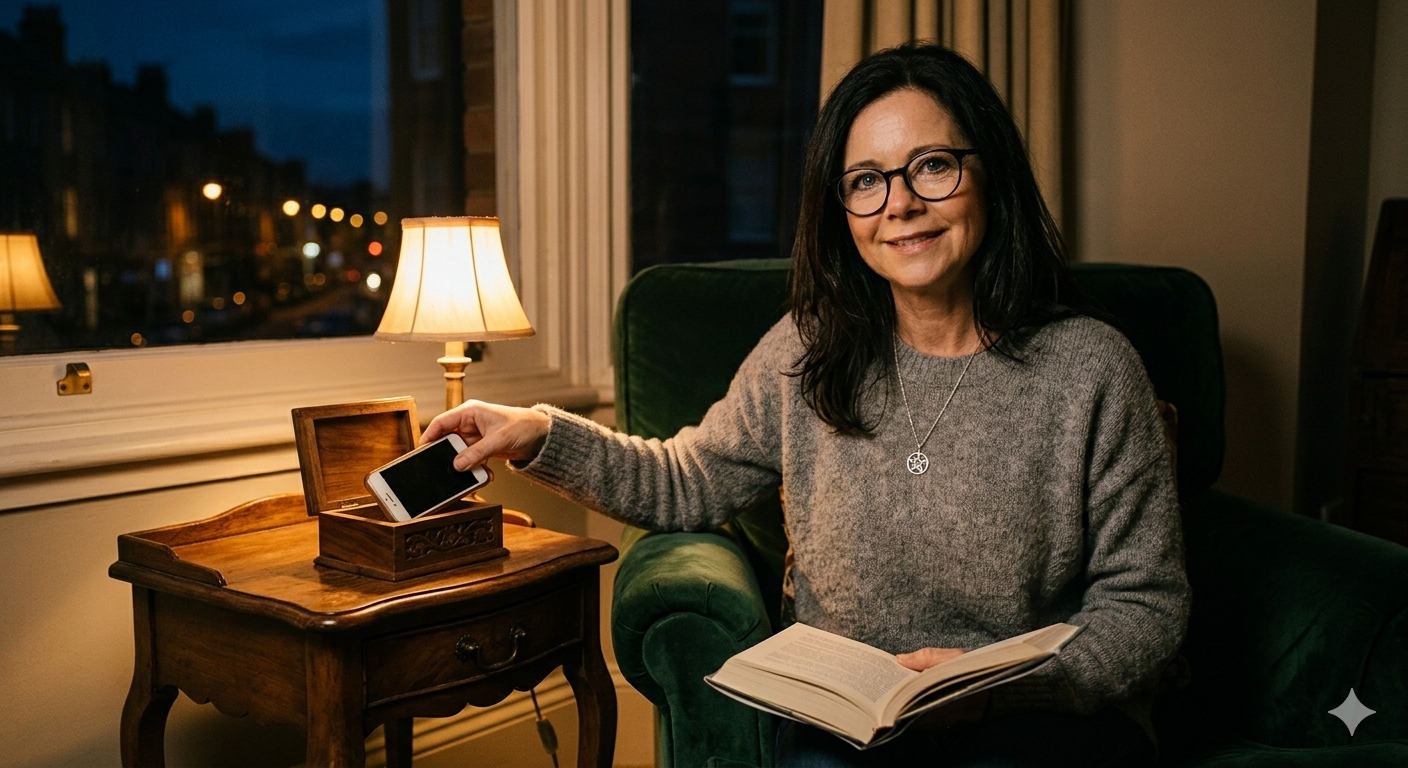
“We live in an age of constant connectivity, but our biology is still tuned to the rising and setting of the sun. I’m sharing how I balance my love for modern tech with old-world sleep hygiene to keep my mental clarity sharp and my spirit rested.” — Mandy
The digital devices we rely on—our smartphones, laptops, and LED televisions—emit a high concentration of blue light. In nature, blue light is entirely normal; it is abundant in daylight and signals to our brain that it’s time to be awake, alert, and focused.
When we stare at a screen late into the night, we are effectively lying to our biology. The photoreceptors in our eyes catch that blue light and signal to the pineal gland that it is still midday. The production of melatonin is instantly suppressed. We might eventually force ourselves to fall asleep, but we miss out on the deep, cellular restoration that only occurs when the pineal gland is allowed to function in true, uninterrupted darkness.
Old-World Sleep Hygiene for a New-Age World
You don’t need to abandon modern technology or move to a remote cabin to heal this relationship. It is entirely possible to enjoy the benefits of our digital age while respecting the ancient needs of your body.
Here is how you can practice a deliberate evening digital detox to honor your internal rhythm:
1. Build a “Digital Sunset”
Just as the sun slowly dips below the horizon, your environment should gradually dim. Establish a hard boundary—ideally 60 to 90 minutes before bed—where all major screens are turned off. Let the world slow down.
2. Guard the Threshold of Darkness
If you must use a screen late in the evening for work or communication, utilize built-in warm filters (like “Night Shift” mode) or invest in a high-quality pair of blue-light blocking glasses. More importantly, ensure your bedroom is a complete sanctuary of darkness. Use blackout curtains or a comfortable eye mask to eliminate the ambient streetlights and charging indicators that can interfere with your pineal gland’s perception of night.
3. Replace Swiping with Stillness
When you eliminate the late-night scroll, you create space for presence. Replace the dopamine hit of social media with old-world rituals that invite the nervous system to settle:
Read a physical book under a warm, low-wattage lamp.
Journal to release the mental clutter of the day.
Sip a cup of caffeine-free herbal tea.
Finding Light in the Dark
A digital detox isn’t about punishment or deprivation; it’s about reclamation. It’s an intentional choice to step out of the artificial, perpetual daylight of the digital world and step back into the healing, restorative shadow of the night.
By closing our physical eyes to the glowing screens of the modern world, we allow the pineal gland to do the work it was designed to do. We protect our mental clarity, support our physical health, and open the door to a deeper, more intuitive state of rest. Tonight, turn off the light of the screen, embrace the dark, and let your inner vision restore itself.